“Sentimental Slush” and Mother’s Day

Woodrow Wilson issued a proclamation declaring the first national Mother’s Day in 1914 as an attempt to honor and show gratitude for biological mothers. Within only a few years, the day had become a profit-driven, superficial commercial holiday directed by florists and mass produced greeting cards. By the Great Depression, even flowers and cards to celebrate Mom were scarce. Instead, women died in childbirth, worked inhumane hours, and saw their children go without food and shoes. For a country to celebrate Mother’s Day in 1931 with superficial gestures of love struck some radicals as hypocritical. One article, from the Working Woman journal, the women’s publication of the American Communist Party, illuminated why communists railed against the holiday. Authored by Margaret Neal, a Party organizer in the South:

From the article:

  • 20,000 women die in childbirth per year
  • Infant mortality is 5x higher for the working class than ruling class
  • Black infant mortality is 8-10x higher than white infant mortality
  • Access to information on birth control is prohibited because capitalism benefits from a large, uneducated working-class
  • No maternity insurance, no free childcare

While many aspects of mothering in the United States have changed, the lack of institutional support for mothers and children, specifically Black mothers and children, have not changed.

Though I would appreciate some flowers or a heartfelt card this Mother’s Day, the “sentimental slush” cannot– MUST NOT– replace our demands for basic improvement for mothers in the United States. These are institutional, costly, but achievable changes that require courageous political leaders to challenge the status quo. The status of mothers has always been political and to claim Mother’s Day as a non-political holiday is misguided and disrespectful for all mothers.

Scottsboro Mothers’ May Day

(An excerpt from my work-in-progress manuscript on the Scottsboro Mothers)

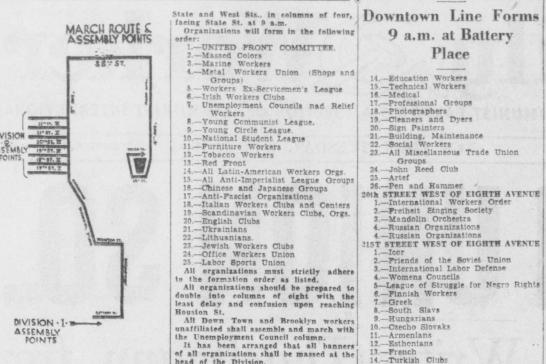
Josephine Powell, Ida Norris, Viola Montgomery, and Mamie Williams joined Ada Wright in New York on April 28, greeting a crowd numbered in the thousands at Pennsylvania Station. From there, a welcome committee escorted them to several workers’ homes where they would reside during their stay in the city.[1] The CPUSA was ready for the parade; the Daily Worker published where and when demonstrators were to meet, the marching divisions they were to join, and even a handy list of lyrics to songs.[2]

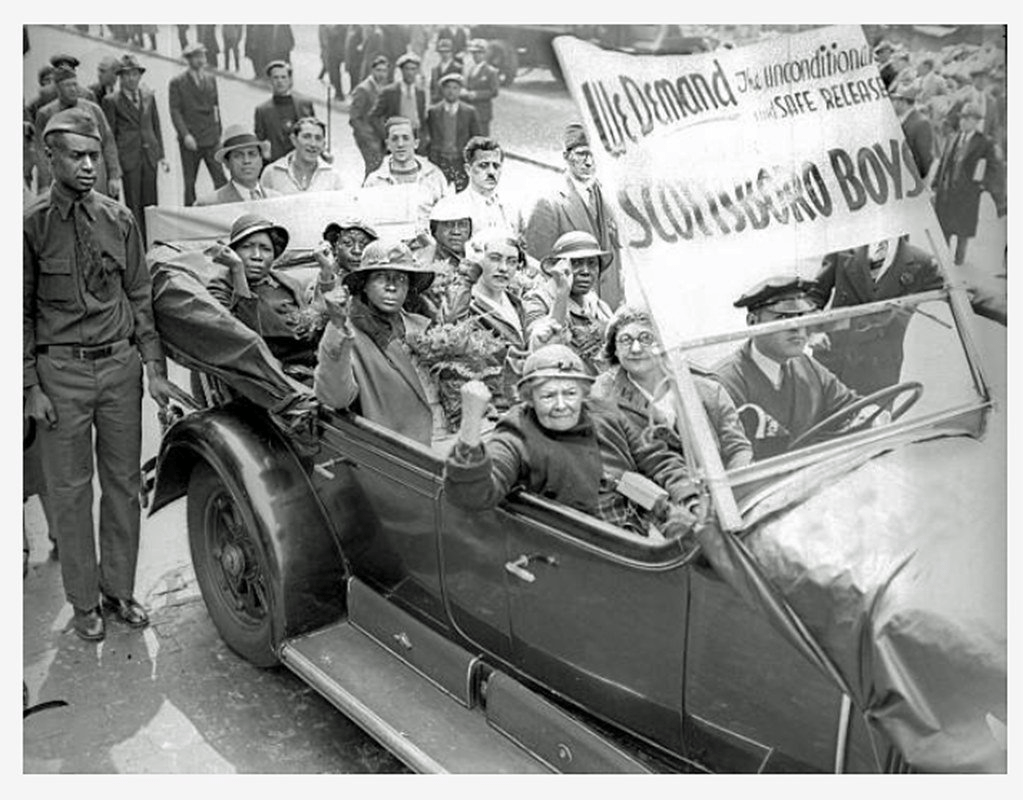
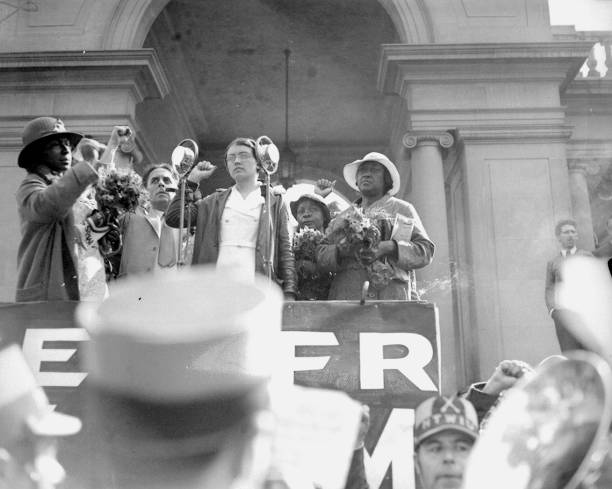
The weather was on their side; a mild and sunny spring day inspired the masses to assemble.[3] An estimated 25,000 men, women, and children marched, representing unions, veterans’ leagues, student organizations, radical groups, and international clubs of Chinese, Spanish, Japanese, Lithuanian, Irish, German, Italian, and Ukrainian workers.[4] A large, black open-top car led the procession, bearing the five Scottsboro Mothers, Ruby Bates, and communist Elle Reeve Bloor. Above the car’s windshield was a banner reading “Immediate and safe release of the Scottsboro Boys.” The mothers carried large bouquets of bright yellow and red flowers, and at one point, stopped on Broadway to pose for a photo. The five mothers and their fellow passengers raised their fists in the time-honored workers’ salute.[5] It was the grandest thing in the world,” Mamie Williams commented, “The comrades sure was marchin’.”[6]

              It took hours for the procession to make its way to Union Square, where a small stage stood. An astonishing 75,000 to 85,000 people gathered at the open-air rally to hear fiery speeches from speakers from the metal, marine, clothing, food, and industrial unions, anti-war groups, students’ leagues, the Unemployed Councils, and CPUSA committees.[7] A “forest of red flags and banners, of placards, trucks, busses, and floats” spilled into the streets.[8] Nearly 2,000 New York City policemen look on, but there were no incidents.[9] As the Scottsboro Mothers passed through the square, they were met with deafening cries of “The Scottsboro Boys shall not die!”[10]

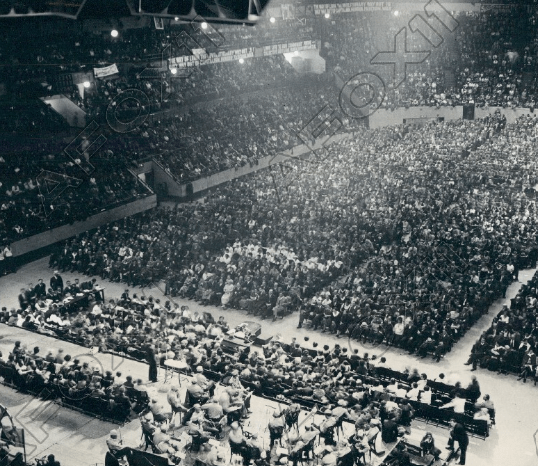
              The culminating event of May Day came that night at Madison Square Garden. At 7pm, workers streamed into the Garden, “electrifying the entire atmosphere of the gigantic arena with roaring avalanche of songs of the revolutionary working class.”[12] The five mothers sat directly behind the speakers’ podium in the front row on the stage. The Baltimore Afro-American later reported the women “were paid an acclaim that a Pope or potentate could well envy.”[13] After speeches from key communist leaders protesting capitalists “bosses,” police violence, Hitlerism, Fascist, and political prisoners, the crowd stood and cheered for several minutes as Janie Patterson approached the microphone to speak to the 17,000 gathered in the arena. “I’m Haywood Patterson’s mother,” she began. “He has been sentenced to die three times on a framed-up charge. Who got the sentence off? The International Labor Defense and the Communists.”[14] Viola Montgomery followed, dramatically declaring, “I’m with you until death separates us.”    


[1] “5 Scottsboro Mothers Arriving Today to Lead May 1 Parade,” Daily Worker, April 28, 1934.

[2] See Daily Worker, April 30, 1934.

[3] “100,000 Reds Hail May Day,” New York Amsterdam News, May 5, 1934.

[4] “United Front Parade of 100,000 Largest May 1st March Ever Held in U.S.,” Daily Worker, May 2, 1934.

[5] “United Front Parade of 100,000 Largest May 1st March Ever Held in U.S.,” Daily Worker, May 2, 1934.

[6] “5 mothers Express Thanks for Fight Waged by ‘Daily,’” Daily Worker, May 11, 1934.

[7] “United Front Parade of 100,000 Largest May 1st March Ever Held in U.S.,” Daily Worker, May 2, 1934; “100,000 Rally Here With No Disorder,” New York Times, May 2, 1934.

[8] “United Front Parade of 100,000 Largest May 1st March Ever Held in U.S.,” Daily Worker, May 2, 1934.

[9] “100,000 Rally Here With No Disorder,” New York Times, May 2, 1934.

[10][10] Otto Hall, “‘They Shall Not Die!’ Cry of Thousands on May Day, Thrills Scottsboro Mothers,” Daily Worker, May 5, 1934.

[11] Sender Garlin, “The Marching Thousands Fling the Words, ‘May Day is Our Day,’” Daily Worker, May 2, 1934; “5 Scottsboro Mothers Cheered,” Baltimore Afro-American, May 5, 1934.

[12] Harry Raymond, “17,000 Meet in Madison Sq. Garden to Hail Greatest New York May Day,” Daily Worker, May 3, 1934.

[13] “5 Scottsboro Mothers Cheered,” Baltimore Afro-American, May 5, 1934.

[14] “United Front Parade of 100,000 Largest May 1st March Ever Held in U.S.,” Daily Worker, May 2, 1934

Maude White Katz

“She Who Would be Free”: Maude White Katz and the Many Fights for Freedom

Maude White Katz did not usually stand down. She had gone up against the roughest cops of New York and Philadelphia and did not go down without a fight. However, in 1954, she was in Atlanta, Georgia as a part of a delegation to free Rosa Lee Ingram and her two sons, who had received life sentences for killing a white man in self-defense. Maude led a group of women to Georgia’s capitol building to address the Board of Pardons and Parole, and once they reached the rotunda, she pushed forward to into the conference room. “Don’t go in there, girl, until I tell you,” a uniformed guard told the fifty-year old, seasoned activist, placing a restraining arm on her. From the Daily Worker’s coverage: “It was a new experience for this cultured Negro woman reared in Pennsylvania. But she merely bit her lip and remained silent. She was in Georgia, and there for one purpose, to free the Ingrams.”[1] Though the Ingrams suffered in prison for several more years, this episode illustrates how Maude White Katz remained an activist for over six decades. She knew her battles and when to fight them.

For most of her activist career, Maude aligned with the CPUSA, and in Harlem, Cleveland, and Philadelphia, she made concrete gains for working-class African Americans. She was trained by Soviets in Moscow and had extensive on-the-ground experience organizing communities. By the time the uniformed guard stopped her in Atlanta, she was one of the leading Black women in the CPSUA. Though Maude White Katz’s name and accomplishments appear in every decade of radical literature from 1920-1970, she has not yet received full biographical treatment. This is not due to lack of information: she left a long and public “paper trail” that is ripe for historical interpretation. This oversight is an injustice: her legacy spanned six decades and her involvement in and dedication to civil, labor, and human rights knew no bounds. This chapter seeks to inspire more work on Maude White Katz, amplifying her role and legacy in American radicalism.

A Ways Toward Freedom

In 1979, in one of her last written works, Maude White Katz wrote an introduction to the republication of the U.N. petition to save Rosa Lee Ingram’s life. The title itself was revealing: “Learning from History—the Ingram Case of the 1940s.” In her short introduction, she wrote that the petition gained tens of thousands of signatures, championed by leading Black figures Mary Church Terrell and W.E.B. DuBois, and even attracted international attention. For Maude, the mobilization of Black Americans to save Ingram and her sons reverberated beyond the 1940s, into the 50s and again in the 60s and 70s, with the civil rights and women’s movements.[2] Though she declined to draw that direct line or make specific references to where the human rights battles of the first part of the century translated into the civil rights battles of the second half, perhaps she did not need to. Maude White Katz was already proof of that alone.


[1] “Georgia Parole Board Denies Plea for Mrs. Ingram,” Daily Worker, May 14, 1954.

[2] Maude White Katz, “Learning From History—The Ingram Case of the 1940s,” Freedomways (Winter 1979), 82.

Edna Griffin

“We Will Not Disappear”: Edna Griffin and Radical Civil Rights in Iowa

On August 20, 1951, in a rare moment free from “diapers, dishes, and dusting,” 41-year-old Edna Griffin sat down to pen a quick note to the recently arrested radical leader, Elizabeth Gurley Flynn. Griffin, a self-described housewife from Des Moines, expressed sympathy that Flynn was taken by police early in the morning, before being able to feed her children breakfast or arrange for their care. Griffin ended the note writing “a Negro mother draws inspiration and energy [from you]”.[1]

Taken alone, this note alone is a sympathetic missive from one mother to another, offering a few words of encouragement during a trying time. However, this was not the first time Griffin had written Gurley. Three and a half years earlier, Edna and her husband Stanley sent Gurley Flynn five dollars for “the defense fund of our Party, a true and steadfast friend of the Negro people.” The Party was the Communist Party of the United States of America (CPUSA), of which Gurley was national treasurer. The Griffin’s financial support of the CPUSA demonstrated a radical ideology coming from the middle-class Black family in Iowa, something so conspicuous, the note made its way to the FBI’s files. For over two decades, the FBI kept a file on the “subversive” activities of the Griffins, Edna especially. The federal government recognized that though Edna Griffin was a physician’s wife, a mother, a church-goer, and a substitute teacher, she was also a committed and astute radical organizer. Griffin’s activist work spanned the 1930s until her death in 2000, and while some of it is famous­—her protest of a segregated drugstore in 1948 led to an “Edna Griffin Day”—and some of it not—some family members did not know of her Communist affiliation until after her death— her persevering critique of American racism, labor exploitation, injustice, and imperialism places her as one of the most important, and overlooked, Black woman radical organizers, activists, and thinkers of the twentieth century.

The Rosa Parks of Iowa?

There is more to Edna Griffin’s story, but the more contemporary accounts of her work are best left to those who knew her personally. What remains her enduring legacy is her multi-faceted, inclusive yet militant approach to struggles against injustice. As Edna Griffin protested police violence against Black veterans, she advocated for right in the Teachers Union. When she demanded her right to sit at Katz drugstore counter, she also fought for justice for an accused rapist. She spoke out against Cold War repression and violence, and defended an incarcerated Black mother and her children in Georgia. She criticized the NAACP, Des Moines City Council, prisons, and nuclear war. She walked with Martin Luther King, Jr., union leaders, communists, miners, and housewives. In 1985, at age 76, she made signs for a protest at a senator’s office who supported aid to the contras in Central America. One day, she went with a group of Quakers to Nebraska to sit in the middle of the highway to prevent transportation of nuclear warhead, an action that led to her arrest. In 1991, she rallied behind Anita Hill’s testimony of sexual assault against Clarence Thomas.[3] In 1985, she was elected to the Iowa Women’s Hall of Fame, an honored she cherished. In 1998, on the fiftieth anniversary of the Katz trial decision, the building that once housed the drug store was officially renamed the Edna Griffin Building. The same year, May 15 was declared “Edna Griffin Day” in Des Moines and she was elected into the Iowa African American Hall of Fame.[4] Perhaps the most fitting honor, though, is a memorial bridge, constructed in 2004, four years after she passed away. Iowa’s Department of Transportation hosted a naming competition, and Mrs. Jenny Schiltz’s fourth grade class at Longfellow Elementary School won the honor with their suggestion of “The Edna M. Griffin Memorial Bridge”. A bridge is an apt metaphor for Edna Griffin’s life; she spent her entire activist career building bridges with groups and organizations from all walks of life, mobilized with the sole purpose of a more just and equitable future. Though she did not always agree with those groups, she astutely understood her role as a piece of a much larger puzzle in the long march towards liberation. As a communist, she often had to hide or disguise her truly radical opinions, but she remained a committed revolutionary. I like to think Mrs. Schlitz’s fourth grade class knew exactly what they were doing when they named the bridge after her.


[1] Federal Bureau of Investigation, “Office Memorandum 12/13/51 RE: Edna Griffin, Security Matter -C,” file #100-355489 (Hereafter FBI, “Memo”). I am indebted to Noah Lawrence for obtaining these records through a Freedom of Information Act request, 8/16/2006.

[3] “May 1985 Newsletter,” Women’s International League for Peace and Freedom Papers, Box 2: WILPF: Newsletters, 1970-1989, IWA-UIL; Holly Smith, “Backers gather to discuss bold move by accuser Hill,” Des Moines Register, October 14, 1991.

[4] Iowa Department of Transportation, “Edna M. Griffin Memorial Bridge,” https://iowadot.gov/autotrails/EdnaGriffinMemorialBridge.

Eleanor Rye Broady

“We Will Accept No Less”: Eleanor Rye Broady and Re-inventing Radicalism

Eleanor Rye Broady was not one to mince words. Even in official correspondences, she wielded an acerbic wit and caustic vocabulary. In one letter to John P. Davis, Executive Secretary of the National Negro Congress, she opened with “If I was to write like I feel, I would have to put the letter in an asbestos envelope.”[1] Evidently, recipients of her letters needed some protection against her passionate composition. Her tenacity and vigor, gilded with a layer of sarcasm and sometimes even cynicism, propelled her life of activism, from the stockyards of Chicago to the steel mills of Indiana Harbor to the streets of Los Angeles. The Red Scare harshly thwarted her political activity, necessitating a year underground. Revelations about Soviet communism severely challenged her long-standing beliefs in the Communist Party. However, her ability to adapt and re-invent radicalism for her own pursuits sustained her lifetime of advocating for Black women and workers.  

In her life, she witnessed two instances of mass violence against Black citizens—the 1919 Chicago Race Riot and the 1965 Watts Uprising. She built a strong interracial union that has over one million members today. She pushed for Black bankers’ employment, workers’ insurance, and freedom for South African political prisoners. The twist and turns of her life and the world around her necessitated re-imagining radicalism at every stage. Through what organization can one best work for justice? Who are the best allies? What strategies will rally all people? Yet one thing remained consistent: in the words of one comrade, she was “above all a revolutionary Marxist. She identified with the cause of the liberation of humanity through the world socialist revolution, and she stayed course to the day of her death.”[2]

Longtime Revolutionary Fighter

On October 4, 1970, almost one hundred family members, friends, and comrades gathered at the Socialist Workers Party hall in Los Angeles to commemorate the life of Eleanor Broady. Speakers mentioned her work with the NNC, the Alexander Defense Committee, the steelworkers, Woolworth’s, and the SWP. George Novack described how Eleanor stayed fully committed to the “cause of liberation of humanity through the world socialist revolution and she stayed on that course to the day of her death.” Others who knew her affirmed that statement, declaring she was a comrade, a friend, and an independent woman. She was also an example, and Novack closed his statements reflecting on the younger generation of activists present who look for their heroes. “Eleanor was above all a revolutionary Marxist… Remember her for that—and if you do, her work will not have ended here.”[3] Her work indeed continues.


[1] Eleanor Rye to John P. Davis, August 12, 1937, Papers of the National Negro Congress (Hereafter, NNC), Pt. 1, Reel 7, New York Public Library, Schomburg Center for Research in Black Culture (Hereafter, NYPL-SCRBC).

[2] Della Rossa, “Los Angeles Tribute to Eleanor Broady,” Militant, 23, no. 39 (October 23, 1970), 17.

[3] Rossa, “Los Angeles Tribute,” 17.


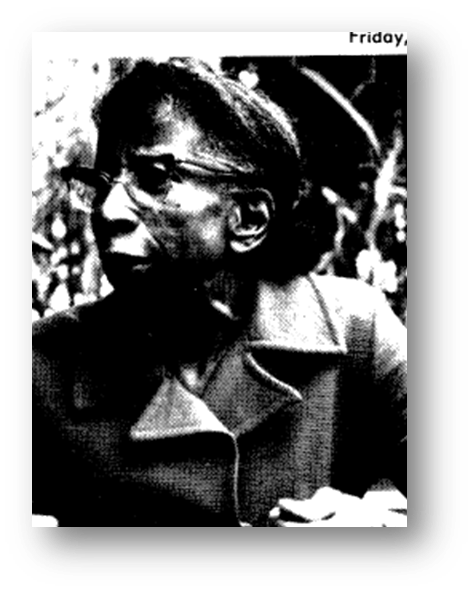
Romania Ferguson

The “Mother of the Southside”: Romania Ferguson and Chicago’s Black Working Class

Photo courtesy of Wayne State University Archives, via Ani Mukherji.

Romania Ferguson had a dilemma. She was a young labor organizer out of the Southside of Chicago, trained at a labor college, and energetic and capable. However, in 1929, the labor movement was splintering; unionists were increasingly separating into communist or non-communist camps. Even those sympathetic with the communist cause distanced themselves from the Communist Party and the radical left. Romania, or Romey, as she was known, had to make a choice. She expressed her decision in a letter to A.J. Muste, a friend, mentor, and director of Brookwood Labor College. “I have established myself with the Left Wing,” she told him, “and intend to carry out its principles to the best of my ability, because I always have and still maintain that a worker can not sit on the fence.”[1] Muste, a radical political activist and passivist, understood, and though he did not agree with her decision, he wished her well.[2] Thus began Romey’s decades-long commitment to the Communist Party.

Romania Ferguson’s work with the Party offered her incredible opportunities, from a free education at the International Lenin School in Moscow to leading Chicago’s first successful strike among Black women workers to running for state-wide political offices. However, her membership also inflicted great frustrations, as she was often overlooked for her work on the Southside. Her marriage to Ray Hansborough, a leading author and theoretician in the Party, did not help when it came to recognition of her contributions. When Hansborough died in 1950s, Romania felt abandoned and alone, and little is known about her life after. American Communist histories do not mention her, Chicago labor historians forgot her, and only a scattering of written works remember her at all. Ironically, the federal government seems to have paid the most attention to her, with over 1000 pages of surveillance records. However, the waiting list for those records are years and years, and so available historical records are tantalizingly scant.

And yet, Romania Ferguson’s life offers great lessons in dedicating a life to a political ideology. Romania “towed the line” when it came to Party doctrine and discipline. While this led to her Black comrades labeling her an “Uncle Tom”, she remained steadfast in her beliefs that the Communist Party was the best vehicle for working class liberation. Her dealings with Party teachings, leaders, and politics reveal the complexities of being a Black woman in the Party, yet she never succumbed to indifference.

Romania’s Story: To Be Continued?

After Raymond’s death, Romania disappeared from public communist records. Hansbrough continued to be commemorated; in 1974, the 55-year anniversary of the CPUSA, general secretary Gus Hall listed Hansbrough among those he “saluted,” members of the Party who had “left their mark on our Party’s development and on the course of United States working-class history.” In the 70s, the local Milwaukee communist Party was known as “The Ray Hansbrough Club. The Illinois Labor History society website lists Hansbrough as a notable Illinois Labor Leader, who was married to “Amelia Ferguson, a civil rights leader.” They could not even get her name right.[3]

In 1953, an FBI informant described Romania as “one of the top Negro women communists in the country”.[4] Ironically, those accolades from a federal government informer were more than any she ever received from the Communist Party. Yet Ferguson never sought out accolades nor recognition. She steadfastly defended the CPUSA and its policies, eloquently arguing for increased attention towards Black Chicago workers. She was one of the first to publish theories on the special oppression of Black women workers, identifying their marginalized status not as a barrier, but an opportunity. She helped organize tone of the first successful strikes in Depression-era Chicago, working with women who had never seen a union before. She helped forge more just, response, and equal Party. That she has been forgotten by the Party she served loyally for decades speaks more about the Party than her.  


[1] Romania Ferguson, letter to A.J. Muste, October 22, 1929, Brookwood Labor College Records, Series 4: Correspondence with Former Brookwood Students, “Romania Ferguson,” Walter Reuther Library, Wayne State University Libraries (hereafter WRL-WSU). My thanks to Ani Mukherji for sharing this research with me.

[2] A.J. Muste, letter to Romania Ferguson, October 28, 1929, Brookwood Labor College Records, Series 4: Correspondence with Former Brookwood Students, “Romania Ferguson,” WRL-WSU.

[3] Gus Hall, “At 55, Well and Fighting,” Daily World, September 7, 1974.

[4] Federal Bureau of Investigation, “Report: Subject Morris Childs,” 1953, File #134-46-1B1, n.p.

Mattielee Woodson Hawkins

“United to Win:” Mattielee Woodson Hawkins and the Auto Industry in Detroit

Mattielee Woodson Hawkins was called “outstanding” several times in her life.[1] The Black press, the Civil Rights Congress, and the Daily Worker all acknowledged her contributions to civil rights, labor organizing, and advocacy for immigrants. Yet, one would be hard-pressed to find mention of her in any radical texts of labor or civil rights activism in Detroit. Like many Black women who participated in radical organizing mid-century, Mattielee’s contributions were overshadowed by her male counterparts. Detroit was a one industry town, and that automobile industry did not include many Black women workers. Black women, since they were not on the factory floors or working on heavy machinery, were seen as ancillary to the city’s working-class struggles. However, that marginalization was a point of empowerment, and Mattielee wielded that power to the best of her ability. As a Black woman, wife, and mother, Mattielee consistently pushed Detroit to re-envision what a working-class activist looked like. She was on the front lines of the Ford Hunger March, supported radical immigrants facing deportation, vocally criticized the U.S. Army, and, according to one agent of the stage, a “trouble-maker”. Though records of her are scant compared to the other women in this volume, Mattielee’s life is a revealing example of the very different experiences Black women had in the CPUSA. She would not publish any articles nor attend major conventions, yet her legacy lives on in important, ground-breaking ways.

Conclusion?

There is no satisfying conclusion to Mattielee Woodson Hawkins’s story. The last public records of her end with her saving her son. Despite her long involvement in the CPUSA and radical organizations, the FBI never surveilled her, at least not to the point they opened an individual file on her.[2] The historical record has dried up. There is an emptiness when a historian cannot tell the entire story of a remarkable woman, but the information we do have paints a beautiful portrait of an organizer, mother, wife, and friend. She was fearless, putting herself in harm’s way during the Ford Hunger March to assist an injured comrade. She was committed, pursuing legal action against a racist restaurant owner several times, and spending years organizing Ford Motor Company. She was strategic, knowing how to form alliances, build coalitions, and establish a united front that would outlast the 1930s. She was caring, working to protect her friend Mary Gosman Scarborough from deportation and her son from court martial. The Communist Party was a better Party because Mattielee was a member.


[1] “Browder to Talk in Detroit on Thursday,” Daily Worker, November 10, 1942; “Communists Call Win the War Meet,” March 27, 1943; Civil Rights Committee, Bulletin for Action 1, no. 5 (May 1951), 2.

[2] The National Archives responded to a 2019 Freedom of Information Act request saying they had no record of Mattielee Woodson Hawkins.

The Un-Essay

I’ve recently started to trend away from assigning traditional essays, influence partially by the rise of AI issues, but also because I’ve always been curious about different ways in which historical research can be presented. During my last semester in college, an English professor offered me this chance, and I wrote my most memorable assignment: a one-act play on the Federal Theater. I still remember the challenges (and fun!) I had in that assignment. So thank you, Prof. Rosenwald!

For history, an un-essay requires all the work of a traditional research paper: primary source, rigorous analysis, interpretation of secondary sources, an argument, and clear organization. In short, the students do all the work of a regular research essay, but never write it. Instead, they demonstrate their mastery of a certain topic in a creative way. In the past, I’ve had podcasts, teaching plans, a film noire style video on the dangers of bootlegging (for a 1920s class!), documentary about women in horror movies, collages, zines, and more.

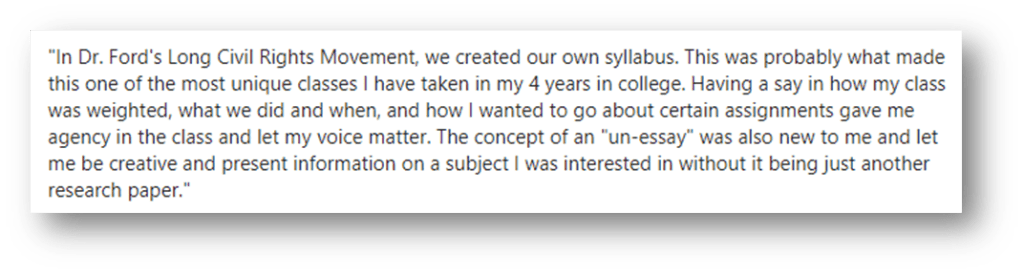
Students respond initially pretty timidly- a “world is your oyster” approach can be intimidating for undergraduates. However, with examples and encouragement, they have responded overwhelmingly positively. Here’s some feedback I received for my HIST 326: The Long Civil Rights Movement class:

Here are a few highlights of un-essays I’ve received in the past few years (presented with permission):

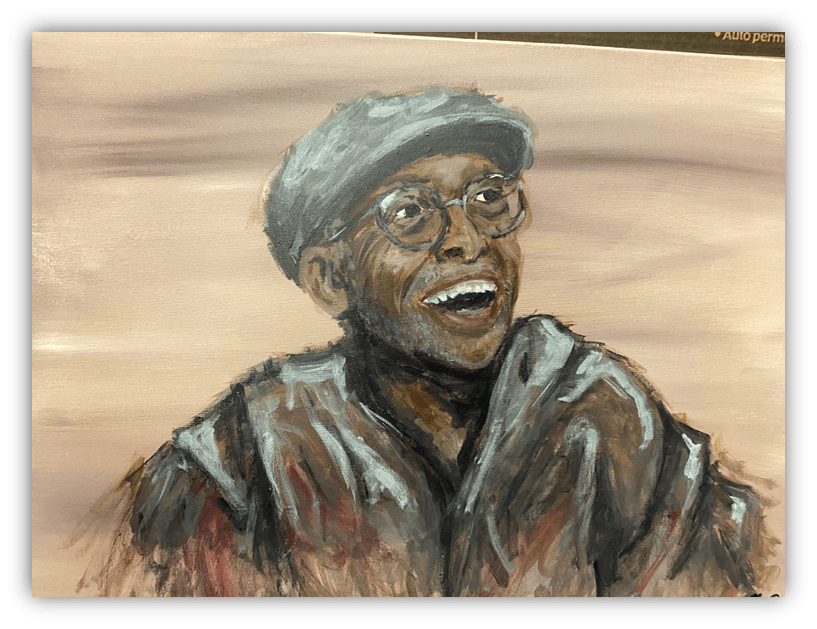
Portrait of Amiri Baraka accompanied by a Bob Ross style video, narrating Baraka’s life and involvement in the Black Arts Movement.
“Prohibition Palate” monopoly, featuring new food technology and trends of the 1920s.
Anthology of poems, edited with introduction and notes by student.
Jackie Robinson video game, featuring historical context and media coverage of Robinson.
Scrapbook/vision board of Assata Shakur (accompanied by an essay)
Video on mini golf in the 1920s and how it reflected the changing dating culture of the era.
Video of student making the original pineapple upside cake (accompanied by historical context about food industry in the 1920s). The student even brought in a sample for me!

In short- I love un-essays. I am consistently impressed by my students’ creativity and talent. While there have been some “duds,” I find students who choose the option of un-essays are highly motivated and have a clear vision. The most important thing is to have clear expectations and markers for students to hit (such as analyzing one primary source, having an argument, citing sources). After that, it’s up to them!

Mother’s Day

The radical Communist Party is not famous for their stance on mother’s rights, but during the Great Depression, when children starved and milk was poured in drains to control inflation, mothers joined forces with the Communist Party to fight for their children.

The most famous instance of Depression-era mother-oriented Party activism was the Scottsboro Mothers, who traveled the country (and, for Ada Wright, the world!) to fight for their sons who were falsely imprisoned. Today, the term “Scottsboro Boys” is associated with racial injustice, but the term “Scottsboro Mothers” is unheralded. Though others have written about the Scottsboro Boys, there has yet to be a book dedicated to the brave women who refused to let their sons die in prison. Denise Lynn has a great article highlighting some of their activism. (See also e James A. Miller, Susan Pennybacker, and Eve Rosenhaft, “Mother Ada Wright and the International Campaign to Free the Scottsboro Boys, 1931-1934,” (2001) and Lashawn Harris, “Running with the Reds: African American Women and the Communist Party during the Great Depression (2009))

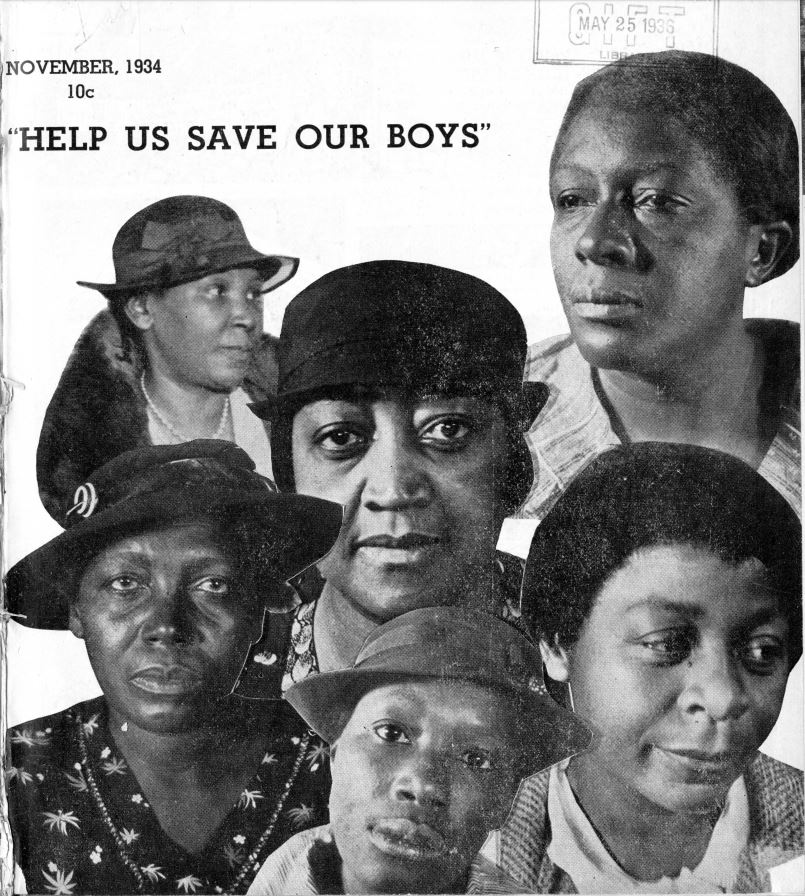
Some images from the Labor Defender, 1932 and 1934 depicting the women:

But the CPUSA’s depiction of the Scottsboro Mother was problematic. Also these women were courageous, outspoken, opinionated, and had their own views, they are often represented as weary, sympathetic, and resigned. I write more about it in a paper I presented at the American Studies Association here.

Lastly (But really not, because there’s much more to be said), white women were engaged at the top level of the Party to advocate for mothers’ rights. Grace Hutchins wrote the Party pamphlet, “Women Who Work,” “What Every Working Woman Wants,” and advocated for “A Mother’s Bill of Rights.” Among the demands: free birth control clinics, free day care, health insurance, unemployment insurance, and maternity insurance, demands we are unfortunately still fighting for today. (For more, see NYC LGTB Historic Sites page on Hutchins and her partner Anna Rochester and Julia Allen’s Passionate Commitments: The Lives of Anna Rochester and Grace Hutchins).

.