“We Will Accept No Less”: Eleanor Rye Broady and Re-inventing Radicalism
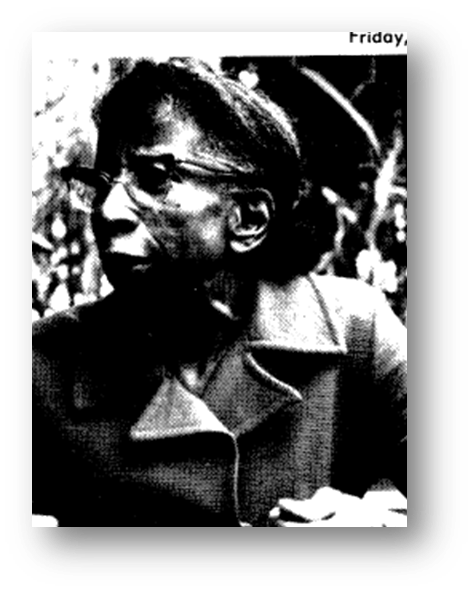
Eleanor Rye Broady was not one to mince words. Even in official correspondences, she wielded an acerbic wit and caustic vocabulary. In one letter to John P. Davis, Executive Secretary of the National Negro Congress, she opened with “If I was to write like I feel, I would have to put the letter in an asbestos envelope.”[1] Evidently, recipients of her letters needed some protection against her passionate composition. Her tenacity and vigor, gilded with a layer of sarcasm and sometimes even cynicism, propelled her life of activism, from the stockyards of Chicago to the steel mills of Indiana Harbor to the streets of Los Angeles. The Red Scare harshly thwarted her political activity, necessitating a year underground. Revelations about Soviet communism severely challenged her long-standing beliefs in the Communist Party. However, her ability to adapt and re-invent radicalism for her own pursuits sustained her lifetime of advocating for Black women and workers.
In her life, she witnessed two instances of mass violence against Black citizens—the 1919 Chicago Race Riot and the 1965 Watts Uprising. She built a strong interracial union that has over one million members today. She pushed for Black bankers’ employment, workers’ insurance, and freedom for South African political prisoners. The twist and turns of her life and the world around her necessitated re-imagining radicalism at every stage. Through what organization can one best work for justice? Who are the best allies? What strategies will rally all people? Yet one thing remained consistent: in the words of one comrade, she was “above all a revolutionary Marxist. She identified with the cause of the liberation of humanity through the world socialist revolution, and she stayed course to the day of her death.”[2]
Longtime Revolutionary Fighter
On October 4, 1970, almost one hundred family members, friends, and comrades gathered at the Socialist Workers Party hall in Los Angeles to commemorate the life of Eleanor Broady. Speakers mentioned her work with the NNC, the Alexander Defense Committee, the steelworkers, Woolworth’s, and the SWP. George Novack described how Eleanor stayed fully committed to the “cause of liberation of humanity through the world socialist revolution and she stayed on that course to the day of her death.” Others who knew her affirmed that statement, declaring she was a comrade, a friend, and an independent woman. She was also an example, and Novack closed his statements reflecting on the younger generation of activists present who look for their heroes. “Eleanor was above all a revolutionary Marxist… Remember her for that—and if you do, her work will not have ended here.”[3] Her work indeed continues.
[1] Eleanor Rye to John P. Davis, August 12, 1937, Papers of the National Negro Congress (Hereafter, NNC), Pt. 1, Reel 7, New York Public Library, Schomburg Center for Research in Black Culture (Hereafter, NYPL-SCRBC).
[2] Della Rossa, “Los Angeles Tribute to Eleanor Broady,” Militant, 23, no. 39 (October 23, 1970), 17.
[3] Rossa, “Los Angeles Tribute,” 17.
 Melissa Ford, Phd